LISTEN TO THE EPISODE
By the late fifties, Teddy Edwards had become one of Los Angeles’s most dependable tenor saxophonists — the guy who could swing hard or lay back smooth, whatever the session demanded. Sunset Eyes, cut for Richard Bock’s Pacific Jazz label in 1960, captures Edwards at his most lyrical — working through standards and originals with a revolving cast of first-call West Coast players including pianist Joe Castro, bassist Leroy Vinnegar, and drummer Billy Higgins. It’s jazz that swings like bebop but breathes like chamber music.
In this episode of Deep in the Stacks, we listen to what happens when a hard-bop tenor player decides the space between the notes matters more than the notes themselves — and why Sunset Eyes remains proof that sometimes the most personal jazz comes from playing it straight but playing it true.
THE RECORD

ABOUT THE ARTIST
Teddy Edwards
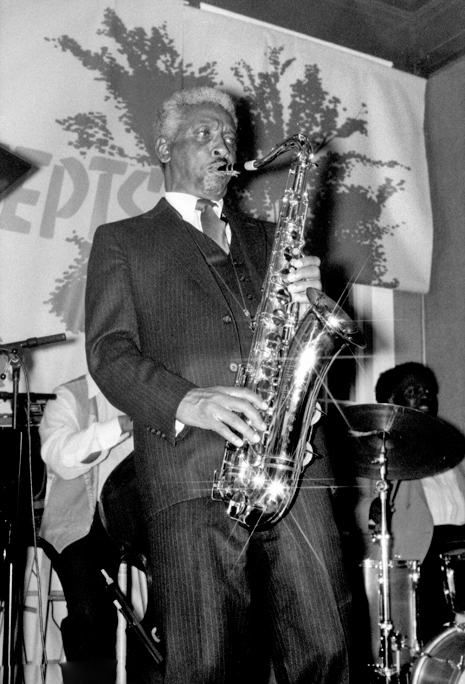
Theodore Marcus “Teddy” Edwards (1924–2003) grew up in Jackson, Mississippi, picked up the alto saxophone early, and toured with Ernie Fields’s territory band before landing in Los Angeles in 1945. When Howard McGhee needed a tenor player with bebop fluency for his new group, Edwards made the switch — and never looked back. By 1947 he’d already recorded “The Duel” with Dexter Gordon, one of the earliest and most celebrated tenor saxophone battles in jazz history, establishing himself as a central figure on the Central Avenue scene.
Edwards stayed rooted in L.A. through the fifties and sixties, building a discography that swung harder than the cool school but shared its sophistication. His key albums as leader include Teddy’s Ready! (Contemporary, 1960) and Sunset Eyes (Pacific Jazz, 1960), both recorded in the same year with overlapping personnel. He also logged sideman dates with Howard McGhee, Benny Carter, and Gerald Wilson’s big band, proving equally comfortable in small groups and large ensembles.
Edwards continued recording and performing into the 1990s, earning overdue recognition with a series of well-received albums on Verve and HighNote. He died in 2003 at seventy-eight — a quiet giant of the tenor saxophone whose best playing always sounded like a conversation, not a performance. Explore more episodes.
SESSION DETAILS
Recorded
August 1959 & March–August 1960
Studio
Rex Production Studio
Los Angeles, CA
Producer
Richard Bock
Engineer
Richard Bock
Personnel
Joe Castro — piano
Ronnie Ball — piano
Amos Trice — piano
Leroy Vinnegar — bass
Ben Tucker — bass
Billy Higgins — drums
Al Levitt — drums
WHY THIS ALBUM MATTERS
Sunset Eyes matters because it documents Teddy Edwards at the peak of a West Coast tenor tradition that never got the East Coast press it deserved. Edwards had been on the LA scene since the 1940s, sparring with Dexter Gordon in the legendary tenor battles at the Bird in the Basket; by 1960 he had become the elder statesman the next generation — Sonny Criss, Harold Land — looked to. Pacific Jazz under Richard Bock was the West Coast counterweight to Blue Note, and this album shows what the label could do with a hard-bop date when it stopped chasing the cool-school sound. Joe Castro's piano and Leroy Vinnegar's bass walk are textbook LA rhythm section — relaxed, swinging, deceptively deep.

Side 1

Side 2
Pacific Jazz PJ-14 · Original mono pressing
New episodes every weekday.
Listen to Deep in the Stacks wherever you get your podcasts, or visit us at Kissa Kissa in Crown Heights.